
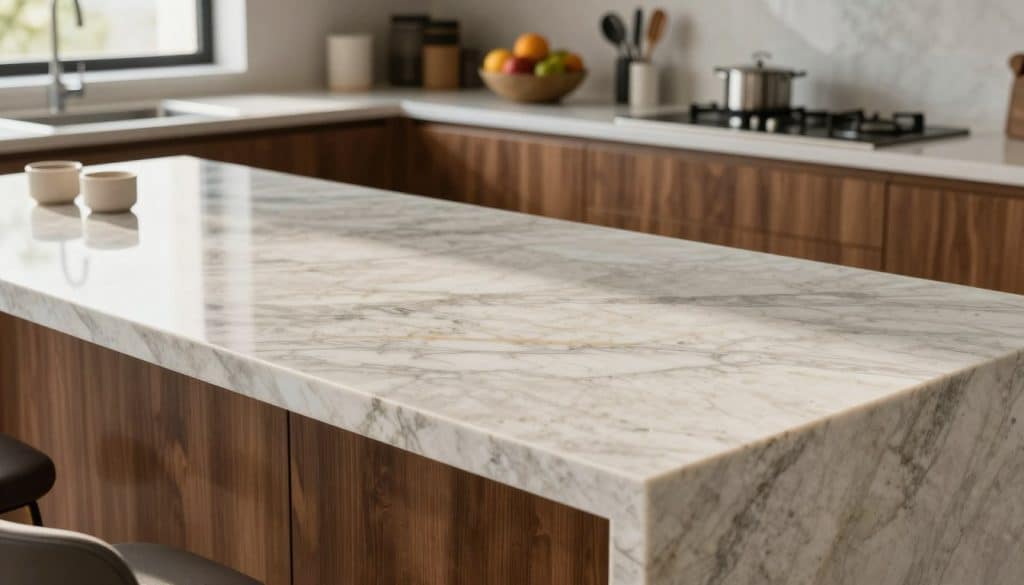
Curious what a single measurement can do to your daily flow and design? Or how deep is kitchen counter? We’ll answer that question and give clear steps you can use before you buy or replace a surface.
The front-edge-to-back-edge measurement defines countertop depth. In most U.S. homes the common standard lands near 25.5 inches—24-inch base cabinets plus about a 1.5-inch overhang. That number affects comfort, workflow, and how your space looks every day.
At Rock Solid Tops we help Minneapolis homeowners choose the right stone. With 30+ years of fabrication and installation experience, we make selections and measurements simple. Our Craftmanship, Your Vision.
We’ll explain what fabricators need before quartz or granite is cut, and the trade-offs between a deeper surface and cost or reachability. If you’re within an hour of the Twin Cities, call (612) 270-4239 or email info@rocksolidtops.com for a free estimate. We often install fast—sometimes in as little as one week after measuring!
Key Takeaways
- Typical countertop depth is about 25.5 inches in most U.S. homes.
- Depth influences comfort, workflow, and the look of your kitchen.
- Fabricators need accurate cabinet and wall measurements before cutting stone.
- Quartz and granite choices affect cost and maintenance; we guide those decisions.
- Rock Solid Tops serves Minneapolis–St. Paul with fast measurement and installation.
Kitchen countertop depth basics: what “depth” means and why it matters
Understanding depth starts with the front edge. Measure from the front edge (including any overhang) back to the wall or backsplash. That number tells you the usable space on the surface and how close you stand while you work.
Countertop depth vs. width vs. height
Depth runs front-to-back. Width or length runs left-to-right along cabinets. Height is the floor-to-top measurement — typically about 36 inches in a standard kitchen. These are different dimensions and each affects layout and comfort.
Why depth affects workflow and reach
Depth controls where you set groceries, where small appliances sit, and whether the back feels out of reach. Too much depth makes the rear hard to access. Too little depth leaves little workspace and creates clutter.
Surface choice like quartz or granite won’t change what depth means. But material affects fabrication planning when you order custom sizes. We guide measurements so your vision works in real life.
- Depth = front edge to backsplash.
- Height ≈ 36 inches in many homes.
- Pick depth that balances comfort, appliance footprint, and style.
How deep is kitchen counter in most U.S. homes?
A simple front-to-back figure often decides whether a surface feels roomy or cramped. We’ll name the common standard and explain why it works for most homeowners.
The standard measurement: 25.5 inches explained
Most perimeter countertops usually measure about 25.5 inches. That number gives usable workspace without putting the rear edge out of reach.
Why 24-inch base cabinets plus a 1.5-inch overhang set the standard
Base cabinets are typically 24 inches deep. Fabricators add roughly a 1.5-inch overhang to protect cabinet faces and create a comfortable edge. The overhang helps spills pass past fronts and keeps drawers clearing properly.
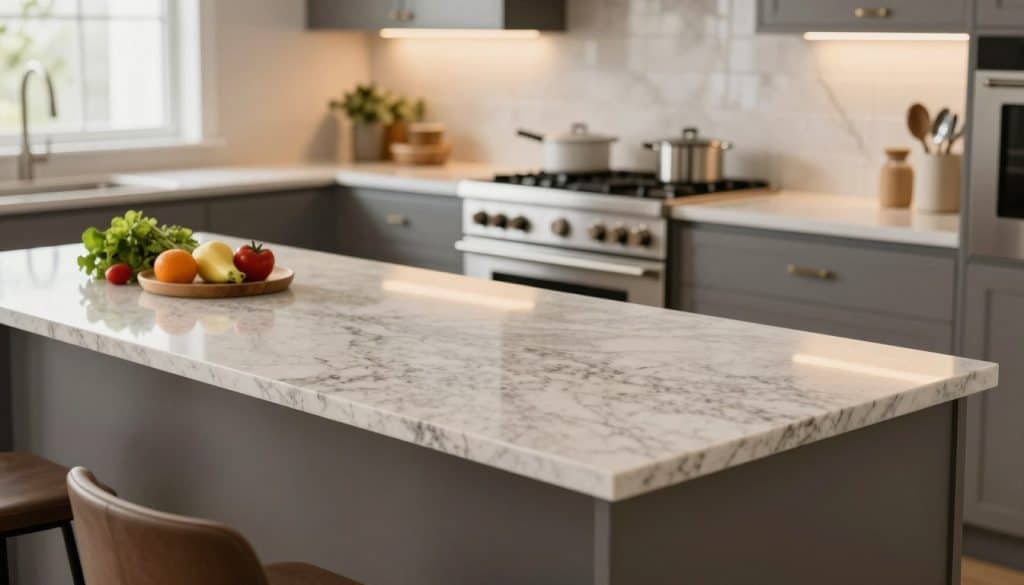
Common real-world variations: 25 and 24.5 inches
Installers sometimes cut to 25 or 24.5 inches to fit uneven walls or tight layouts. Older homes and custom cabinetry may use other numbers.
- 25.5 inches = common standard depth.
- 25 or 24.5 inches = on-site adjustments for fit.
- Know your measurement before ordering materials and seams.
How to measure countertop depth correctly before you buy or replace
A quick, repeatable measurement routine keeps your project on schedule and on budget. Start with a tape measure and a straightedge. Identify the back edge where the surface meets the wall or backsplash.
Tools and prep
Use a tape measure, pencil, and straightedge to check for bowed or uneven walls. Mark cabinet ends, appliance gaps, and any bump-outs before you measure.
Exact measurement that matters
Measure from the finished front edge (including any overhang) straight back to the wall or backsplash. Record that number in inches — this is the truecountertop depthwe use for templates and cuts.
Verify cabinets, walls, and clearances
Check cabinet depth and plumbing or outlet clearance behind cabinets. Old walls can vary depending on framing or tile, and that variance can change final dimensions.
Appliance and documentation checks
Appliances like ranges and refrigerators can be deeper than standard units; some pro-style models require custom depth. Write down each run, note appliance locations, take photos, and sketch any corners.
- Measure each run front edge to backsplash in inches.
- Confirm cabinet box depth and wall straightness.
- Note appliances and utility clearances for final cuts.
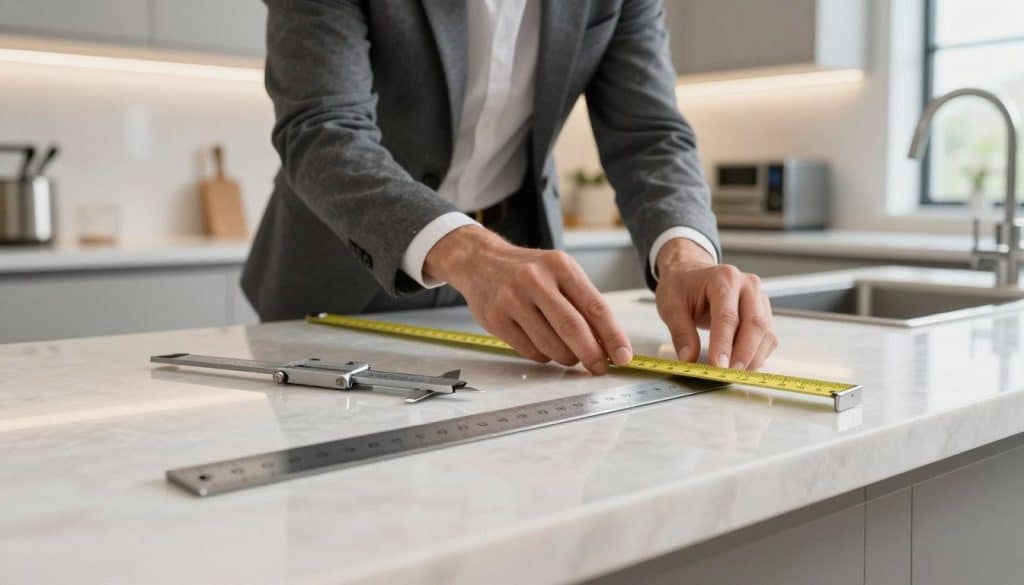
Lean on us. Rock Solid Tops can come to your home or commercial project to measure, advise on design choices, and then fabricate and install quickly—often within one week of templating. Schedule a free estimate and let us handle the details!
When deeper countertops make sense for your space, appliances, and design
Adding a couple of inches to your work surface can change the way you cook and clean. A modest increase to 26–28 inches can improve comfort and give you useful extra room for daily tasks.
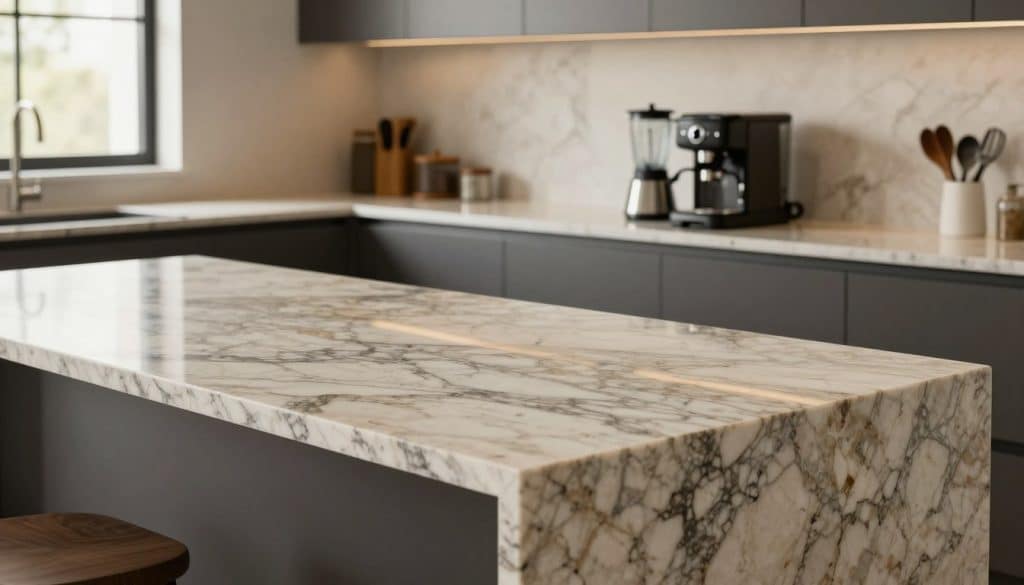
Ergonomics upgrades with 26 to 28 inches of depth
Deeper countertops between 26 and 28 inches create a better buffer from the backsplash. That extra depth reduces wrist strain when chopping and gives a safer prep zone for busy cooks.
Extra workspace for cooking, baking, and small appliances
More surface space means room for baking sheets, mixers, and larger coffee stations. If big appliances tend to squeeze your layout, going wider can free up prime front-of-work area.
Trade-offs to know: harder reach and more material cost
There are trade-offs. The farther back the surface, the tougher it can be to reach items. Some homeowners find the rear edge less usable.
- Aesthetics: In larger rooms, deeper runs can look more proportional.
- Materials: Custom material cuts for nonstandard sizes can raise cost and waste.
- Appliances: Measure your major units first—sizes may vary depending on model and placement.
We help match design and function to your real needs. If your appliances dominate the usual footprint, a slightly wider surface can be the right upgrade for lasting comfort and tidy workflows.
Kitchen island countertop depth and seating: planning for comfort and clearance
A well-sized island blends prep space, seating, and traffic flow without feeling crowded. We’ll walk through typical runs, seating needs, and the clearances that make an island useful every day.
Typical island depths: 27 to 28 inches for added prep space
Many islands run 27–28 inches. That extra room adds real workspace for prep without overwhelming the floor plan. It’s a flexible choice for a standard kitchen layout.
Breakfast bar layouts: why seating often needs at least 30 inches
When you add stools, plan on at least 30 inches of depth. That gives knee room and keeps legs away from cabinet faces. For bar-height seating, match the surface to about 42 inches in height.
Balancing available space, walkway clearance, and functionality
Measure available space before you pick final dimensions. Leave firm walkway clearance so traffic flows while people cook or sit. A good island balances a prep zone with a social zone.
- We’ll explain why islands differ from perimeter runs and where you can safely add depth.
- We’ll confirm clearances so your island fits your available space and lifestyle.
- We’ll match height and surface choices to the intended use—prep, seating, or both.
Conclusion
The final measurement ties design, function, and budget into a single, practical choice. In most U.S. homes the common answer for perimeter runs is 25.5 inches as the standard depth. That size works well with 24-inch cabinets and a modest overhang.
Your final size can vary depending on cabinet depth, appliances, wall or backsplash conditions, and island seating goals. Choose an option that favors functionality first, then refine edge style and materials.
For example: measure the run, confirm cabinet depth, note outlets and plumbing, then finalize the template. Quartz and granite remain excellent surface choices for standard or custom builds.
With 30+ years serving Minneapolis and the Twin Cities, we install fast—often in as little as one week after measuring. Our Craftmanship, Your Vision. Call (612) 270-4239 or email info@rocksolidtops.com for a free estimate!